Words. Do they matter? A few sound waves. Some symbols on a page—today they are gone with the touch of a delete key or swipe of your finger. Yet, we all know that “the pen is mightier than the sword,” right?
Indeed, without the words, there would BE no sword. For words let one sword maker pass knowledge and skills onto the next, who further refined his craft and passed that knowledge onto the next and so on. Without words, swords would never have been developed or refined. It would be easy to argue we would be better off without swords. Yet without words we would not have physics, song, engineering, novels, history— or civilization as we know it. Without words our communication would be stunted— our relationships and connections reduced to their most basic level. Words make true communication possible and communication makes humanity at its best, worst and in between possible. Words make us uniquely human.
Simplicity
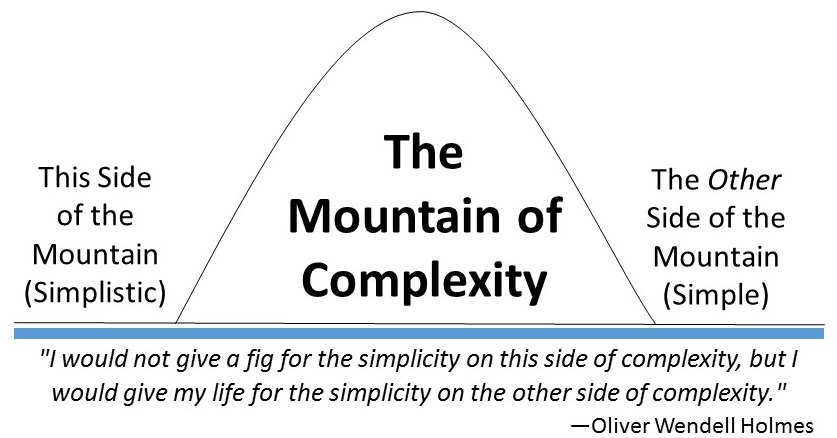
Some people take great satisfaction in utilizing complicated words to communicate. Big words can make us feel sophisticated and masters of some special body of knowledge while everyone else gets to figure out “what did that person just say?” Complicated words may feed our egos-but they often block understanding. How about we use simple words we all understand?
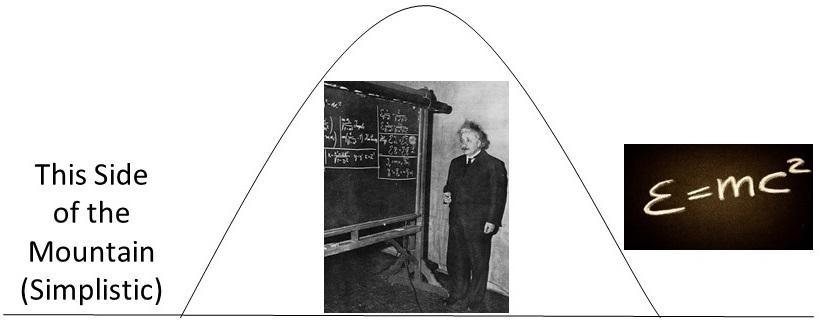 True simplicity is valuable. Albert Einstein got that. So did Steve Jobs. Yet, we often stay mired in complexity. When we get through complexity to the essence of something, we find a core truth that can spark innovation and action in many dimensions. I think of complexity as a mountain of “stuff” that we must work through to get to the powerful, simple truths on the other side of it. Einstein did that by working through huge complexity to develop the theory of relativity. The relationship between energy and matter is certainly a simple and very powerful truth. iPhones aren’t quite at the same level—but they are both simple and sweet!
Performance
Almost every team, business, non-profit (or any group of people) will answer “Of course!” when asked if they’d like to improve their performance. Getting better tomorrow is built into our DNA. But how? There are a huge number of theories, frameworks, models, hypothesis, concepts, tools and really big words on the topic of improving performance. There are so many possibilities to pick from: Capability, talent, competencies, knowledge, skills, engagement, commitment, passion, training, motivation, purpose, execution, extrinsic rewards, discipline, learning, performance, development, accountability, recognition and so many more. All of them with lots of syllables. What if we could reduce the complexity of all that and identify the fundamental drivers of performance? What if we moved through the confusing academic and HR-ish language to what really makes a difference? We might be getting to something that we could all understand, act on and use in many ways to do better tomorrow than we did today.
Simple words are clearer. More powerful. Unmistakable in their meaning. They get to the essence of things.
When it comes to improving our performance, there are three truly simple ideas on the other side of “Mount Complexity.”
Can—do we have the ability to do what we have in mind?
Want—do we want to do it?
Do—are we doing it?
Nothing happens until we get to Do.
Do doesn’t happen without Can and Want.
If we have Can but no Want, nothing happens.
That’s why Want is always the fundamental driver of individual and team performance. Desire beats require— because when we truly, deeply Want to do something, we will do whatever it takes to figure out the Can and then Do it. When we Want to do something Together—almost anything is possible (like putting a man on the moon with less computing power than we have in our “simple” iPhones today). You know it’s true— look at what you’ve accomplished in your own life that makes you proud. What role did Want play in that?
Can. Want. Do. is about these three simple truths that are the formula for performance and results for all individuals and teams (I like the word teams more than organizations—it is simpler and more real).
I’m looking forward to exploring Can, Want and Do with you. That’s exactly what this blog will do. Our journey has begun. Let’s learn together.
P.S. Yes, words are more powerful than swords. After all, if we take words out of swords, all that will be left is an “s”—and there’s not much we can do with that. No matter how much we want to.
 Can. Want. Do!