How many times have you heard the phrase- “If it’s not broken, don’t fix it?” Seems to me that following that concept leads to the kind of complacency that results in big problems for a business, including irrelevancy and business “death.” How is it that what would appear to be capable business people would let words like that come out of their mouths—or live in their minds?
About a year ago, I was meeting with a very successful home builder, with many billions of revenue, thousands of employees and a record of developing profitable residential subdivisions for at least two decades. The business managed its real estate acquisition process differently than its competitors and did a few other things in unique ways that the company’s leadership thought gave them a sustained competitive advantage. Leadership told me (and many others) that they loved their “system” and built their culture and processes to execute their system—and not change a thing. In fact, they purposefully avoided hiring people they saw as change agents to avoid disrupting their system. It had worked for decades—why risk messing up the proven money machine with something unknown?
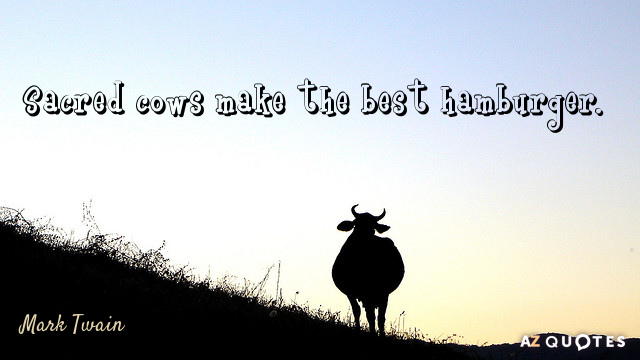
The challenge for that home builder is that someone (likely many more than just one) is already thinking about how to disrupt their model and take away as many customers as they can–maybe all of them. They are working on finding ways that will let them develop new homes faster, better and at a lower cost. Maybe it’s a competitor. Maybe it’s a totally new idea to meet the same customer need.
Imagine how buggy manufacturers were thinking before the automobile was developed—or more recently, how did Kodak respond when digital cameras destroyed the demand for their product? Unbelievable but true–a Kodak employee invented the first digital camera. 
 How about Blackberry, which continued to believe that the security of their proprietary system would protect them from the onslaught of iPhones and Androids? We all know how that worked out.
If we aren’t learning, growing and innovating EVERY DAY, we are on our way to dying—and that applies to individuals and organizations. But individuals and organizations get complacent, like the home builder above, because there isn’t any threat or pain today—or maybe even anywhere on the horizon. That threat to our survival might appear in six months—or twenty years. But it WILL happen—that’s one of the fundamental drivers of civilization—some of us find better ways of doing things—and don’t stop finding even better ways tomorrow. If those people stop improving, some other innovator, “rule”-breaking, game-changing people come along to do the job. If that weren’t true, we’d all still be hunter-gatherers living in caves with an average life span of 35 years.
So we can “sit back and coast” until it is too late and then react—or stay hungry and get better before someone takes our lunch away from us. For individuals, being an innovator might be baked into our personality and talents—but organizations can certainly CHOOSE between complacency and the mix of ingredients that leads to getting better every day. What does it take to do that?
The Right People: starting at the top, the right mix of people is key. That begins with leadership that is never satisfied that today is good enough. Certainly, it’s good to celebrate great results and progress . . . and then—onward to the next step up. Boards and CEOs can help prevent complacency by selecting leaders who are always hungry to get better AND who know how to build an organization that does exactly that. Next: make sure that your selection criteria and assessment processes include purposefully selecting-in people who are curious, hungry, game-changers especially in key functions like R&D, strategic planning, and all “big” leadership roles. Not everyone needs to be an innovator—but purposefully embedding them into the talent mix is key. Developing emerging talent that shows innovative capability is another key step.
A Culture that Fertilizes Innovation: Build a culture that celebrates effective change, continuous improvement and letting go of even the most treasured current ways of doing business to do something better. Communication, recognition, leadership behavior, discipline, incentives, processes, policies, metrics, structure, even facility design and colors help build (and change) culture. Headline—after getting the right people, putting them into a culture which nurtures innovation and improvement is essential—otherwise the greatest talent will only partially fulfill the potential they have inside. Or even worse, simply walk away.
Processes that Build Improvement In: Developing and executing processes that encourage innovation builds getting better every day into the rhythm of the business. That can be done by building environmental scanning, benchmarking (especially outside your industry), ideational sessions and decision criteria into your businesses planning and development processes. By doing so, innovating becomes part of the rhythm of your business.
Metrics That Focus: Measure what you treasure—if you care about getting better, put metrics in place. Measure the number of innovations, their effectiveness with stakeholders (expected vs actual impact, ROI, etc.), benchmark them over time against yourself—and your competition. If getting better is measured and reported every year and quarter, you can bet your people will pay attention to it.
Organized Accountability: put accountability into place by clearly assigning responsibility for getting better in your organizational structure, job designs and performance goals. That includes the planning and R&D teams—and a lot more (e.g., product developers/designers, merchants, IT, supply chain, etc.). Drill that accountability down to specific jobs with goals that demand improvement and innovation to achieve (time to use those metrics).
Disciplined Investment: Getting better means trying new things—which means investing to develop and test the ideas. Putting decision criteria and standards at the key steps of your improvement processes is essential—so you invest wisely. But if you don’t put some money into it, it will just be an idea.
The combination of the “soft” enablers of talent and culture with the “hard” drivers of process, accountability, metrics and investment will produce a continuous stream of proven innovation that keeps your business getting better every day.
If you’re not getting better, you are falling behind. We are either growing or dying. There is no plateau. The only question is which path you will choose–for yourself and for your team. If you have any doubt, just ask the folks who used to be at Kodak and Blackberry what they wish they had done. If it isn’t broken . . . Make It Better!
 Can. Want. Do!